Skip to content

Robertson Studio

My WordPress Blog

Menu
  • Sample Page
Menu

NASA Model Wing Lights Up During First Pressure Sensitive Paint Tests

Posted on October 2, 2026

2 min read

Preparations for Next Moonwalk Simulations Underway (and Underwater)
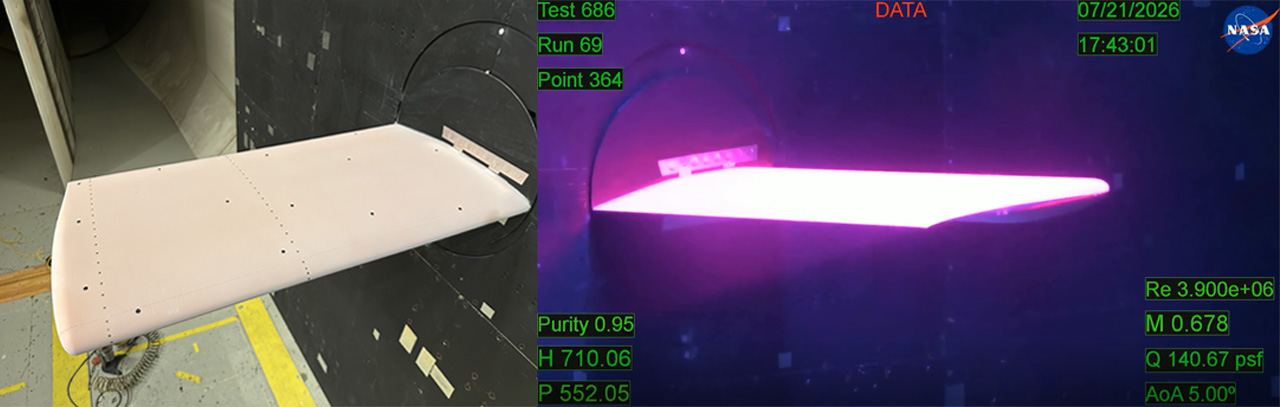
Side‑by‑side images showing a wing-like test article mounted in a wind tunnel. The left image displays the pale, unlit test article attached to instrumentation inside the tunnel. The right image shows the same article under aerodynamic heating, glowing bright pinkish‑purple as test data parameters appear around it, including readings for pressure, temperature, Mach number, and angle of attack.
Left: The Benchmark Supercritical Wing not illuminated in unsteady Pressure Sensitive Paint inside the Transonic Dynamics Tunnel at NASA’s Langley Research Center. Right: The Benchmark Supercritical Wing illuminated in unsteady Pressure Sensitive Paint during testing inside the Transonic Dynamics Tunnel at NASA’s Langley Research Center.
Left: NASA/Sarah Peak | Right: NASA

Groundbreaking tests at NASA’s Langley Research Center in Hampton, Virginia, are paving the way for new wind tunnel capabilities for designing the aircraft technologies of the future. 

In a first-of-its-kind test in NASA Langley’s Transonic Dynamics Tunnel, researchers used unsteady Pressure Sensitive Paint to study how air flows around a standard wind tunnel model known as the Benchmark Supercritical Wing. As the team observed the test, the paint’s special capabilities made the model wing glow pink-purple when exposed to special ultraviolet lights, while high-speed cameras captured every detail. 

The test combined two valuable NASA tools. NASA’s benchmark wings don’t represent a particular type of aircraft, rather they are meant as universal models to help researchers improve computer modeling using wind tunnel data.  

Unsteady pressure sensitive paint is a specialized coating that varies in brightness according to how much pressure the air flow applies to the wing. High-speed cameras capture those changes, providing data for computer models. For years, NASA researchers at centers including Langley and the agency’s Ames Research Center in California’s Silicon Valley have been working to integrate the paint into wind tunnel tests for aircraft and rockets. NASA researchers consider the paint a vital tool and expect to find many more wind tunnel applications in the future.  

This test marked the technique’s first use on a large-scale, freely moving model in a low‑oxygen environment, an achievement made possible by the Transonic Dynamic Tunnel’s unique testing capabilities. 

This milestone opens the door for upcoming tests on flexible aircraft models that are designed to bend and adapt during flight to improve efficiency. It also lays the foundation for better simulations and designs as NASA advances the future of flight. 

Share

Details

Last Updated

Oct 02, 2026

Related Terms

  • Langley Research Center
  • Aeronautics
  • Aeronautics Research Mission Directorate
  • Transformational Tools Technologies
  • Transformative Aeronautics Concepts Program

Explore More

10 min read

2026-2027 DWU: Middle School Design Challenge

Article


1 week ago

9 min read

2026-2027 DWU: High School Engineering Challenge

Article


1 week ago

4 min read

NASA Modernizes Commercial Airline Systems

Article


1 week ago

Source: www.nasa.gov

Leave a Reply Cancel reply

Your email address will not be published. Required fields are marked *

Partners

best sweepstakes casino
no deposit bonus
new online casino

Recent Posts

  • Signers of the Declaration of Independence: Connecticut, Part 2
  • NASA Awards Enterprise Logistics Support Services Agreements
  • 10 Things: Movie Night
  • Rains Swamp the Gandak River
  • APOD: 2026 October 2 – The Complete Sharpless Catalog: 313 Nebulas

Recent Comments

  1. A WordPress Commenter on Hello world!

Archives

  • October 2026
  • September 2026
  • August 2026
  • July 2026

Categories

  • games
  • Uncategorized
©2026 Robertson Studio | Design: Newspaperly WordPress Theme